
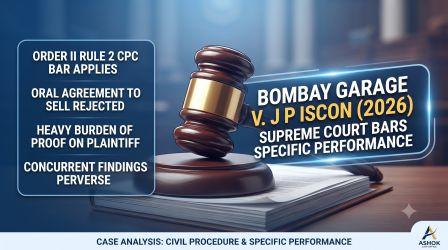
Case Analysis | Civil Procedure | Specific Performance | 2026 INSC 1066
Case at a Glance
| Case Name | Bombay Garage Ahmedabad Limited & Ors. v. J P Iscon Private Ltd. & Anr. |
| Citation | 2026 INSC 1066 (Reportable) |
| Court | Supreme Court of India, Civil Appellate Jurisdiction |
| Case No. | Civil Appeal arising out of SLP (C) No. 25909 of 2024 |
| Date of Judgment | 29 September 2026 |
| Bench | J.B. Pardiwala, J. and K. Vinod Chandran, J. (judgment authored by K. Vinod Chandran, J.) |
| Counsel | Mr. Mihir Thakore, Sr. Adv. (Appellants); Mr. Deven Parikh, Sr. Adv. (Plaintiff-Respondents) |
| Nature of Dispute | Suit for specific performance of an alleged oral agreement to sell property of a company; decreed by Trial Court and affirmed by High Court |
| Key Provisions | Order II Rule 2 CPC; Order XXIII Rule 1(3) CPC; Section 46, Companies Act, 1956 (not decided) |
| Issues | (1) Was the second suit barred by Order II Rule 2 CPC? (2) Was a concluded oral contract proved? |
| Held | Suit barred by Order II Rule 2; concluded contract not proved; concurrent findings perverse |
| Outcome | Appeal allowed; decrees set aside; suit dismissed; parties to bear own costs |
Abstract
In Bombay Garage Ahmedabad Limited & Ors. v. J P Iscon Private Ltd. & Anr. (2026 INSC 1066), the Supreme Court set aside concurrent decrees for specific performance of an alleged oral agreement to sell land. The Court held, first, that a second suit for specific performance was barred by Order II Rule 2 of the Code of Civil Procedure, 1908, because the relief was available, but neither claimed nor reserved with leave, in an earlier injunction suit; liberty sought at the time of withdrawal could not cure that omission. Second, it held that the plaintiffs failed to prove a concluded oral contract, citing shifting pleadings, an un-presented cheque, hearsay evidence and the lack of authority of the negotiator. The ruling refines the interplay between Order II Rule 2 and Order XXIII Rule 1(3), and sets a demanding evidentiary standard for oral agreements to sell immovable property.
1. Introduction
On 29 September 2026, a Bench of Justice J.B. Pardiwala and Justice K. Vinod Chandran delivered a reportable judgment in Bombay Garage Ahmedabad Limited & Ors. v. J P Iscon Private Ltd. & Anr. (2026 INSC 1066), authored by Justice Chandran. The decision tackles two questions that routinely decide specific performance litigation: can a plaintiff who first sues for a bare injunction, and then withdraws that suit, later sue for specific performance; and what quality of proof is needed to establish a concluded oral contract for the sale of immovable property? The Supreme Court answered both against the plaintiff, set aside the concurrent decrees of the Trial Court and the High Court, and dismissed the suit.
2. Factual Background
The plaintiffs asserted an oral agreement to purchase property belonging to the first defendant company. According to the first suit, filed at Mirzapur, three meetings took place. At the first, a price was fixed and a token sum paid. A second meeting was held in the presence of a Solicitor to prepare the title and sale deed. At a third, the defendants demanded a higher price, and Rs. 20.50 crore was agreed. The plaintiffs said they handed over a cheque of Rs. 5 crore on 11.01.2007, that the company sent the original property documents by letter dated 25.11.2006, and that on 08.05.2007 the defendants refused to honour the agreement and dared the plaintiffs to do their worst.
That first suit sought only a permanent injunction restraining alienation, change in the nature of the property and construction. It was withdrawn on a pursis citing ongoing settlement talks and asking for liberty to file afresh, though the withdrawal order did not expressly grant liberty. The plaintiffs then filed a second suit in 2007 for specific performance, later amended in 2011 to add a fresh account of the meetings. The Trial Court decreed the suit and the High Court affirmed. The defendants approached the Supreme Court.
3. Issues Before the Court
A. Whether the second suit for specific performance was barred by Order II Rule 2 of the Code of Civil Procedure, 1908 (CPC), given that the earlier injunction suit was withdrawn without leave to sue for that relief.
B. Whether the plaintiffs proved a concluded oral contract for sale, with consensus ad idem on its vital terms.
4. Contentions
Mr. Mihir Thakore, Senior Counsel for the appellants, argued that the cause of action for specific performance had arisen when the first suit was filed, that no leave was obtained at that stage, and that the second suit was therefore barred. On merits he pointed to inconsistent pleadings, belated amendments, unsubstantiated advance payments and negotiations conducted with a son-in-law who had no authority from the company. He also invoked Section 46 of the Companies Act, 1956.
Mr. Deven Parikh, Senior Counsel for the respondent-plaintiffs, contended that the pursis clearly sought liberty, which must be inferred from the withdrawal order, and that Order XXIII Rule 1(3) rather than Order II Rule 2 governed. The second suit, he said, was filed promptly and within limitation. On facts, he relied on the cash advance and the Rs. 5 crore cheque, the oral testimony, and the evasive answers of the defence witnesses, which he said justified an adverse inference.
5. The Court’s Analysis
A. Oral contracts are valid, but proof is a heavy burden. The Court began by reaffirming Brij Mohan v. Sugra Begum and K. Nanjappa v. R.A. Hameed: no law requires a contract for sale of immovable property to be in writing, but a plaintiff relying on an oral agreement alone bears a heavy burden to prove consensus ad idem on a concluded contract. Strict proof is the norm, and mere inference is impermissible.
B. Maintainability: the Order II Rule 2 bar. The Court took the Constitution Bench decision in Gurbux Singh v. Bhooralal as its anchor. To defeat a second suit, the defendant must establish that the second suit arises from the same cause of action as the first, that the plaintiff was entitled to more than one relief on it, and that the plaintiff omitted the later-claimed relief without leave of the Court. Gurbux Singh also treats the plea as a technical bar that must be established satisfactorily rather than presumed. There, the defendant had not produced the earlier plaint. Here, the Court noted, the plaintiff itself had produced the first plaint (Annexure P19), so the comparison of causes of action rested on the record and not on speculation.
The Court surveyed the case law and concluded that application of the rule turns on facts. It contrasted Virgo Industries and Vurimi Pullarao, where the bar applied because the earlier injunction suits already disclosed a complete cause of action for specific performance, with Inbasagaran, Rathnavati and Sucha Singh Sodhi, where the refusal to perform surfaced only later, through a written statement or a third-party sale. It also discussed Cuddalore Powergen, where a statutory ban on registration meant specific performance was not then available, so courts should avoid technicalities.
Applying these principles, the Court found that the first plaint itself pleaded the meetings, the payments, the transmission of documents and, critically, a clear refusal on 08.05.2007 coupled with a challenge to do whatever the plaintiffs wished. Specific performance was therefore available and entitled to be claimed at that point. It was neither claimed nor was leave sought at institution.
C. Liberty on withdrawal does not cure the omission. The Court held that although the pursis sought liberty and such liberty could be inferred, this did not cure the absence of leave under Order II Rule 2(3) at the time of filing. It drew a clear line between the two provisions. Order II Rule 2 applies where a suit is filed and later withdrawn to file a fresh suit without having claimed all reliefs then available; the second suit survives only if leave was obtained at institution. Order XXIII Rule 1(3) applies where a plaintiff withdraws for sufficient grounds and is permitted to sue afresh on the same subject-matter or part of the claim, not for a new relief. The plaintiffs’ argument that they could simply have amended the first suit only underscored the omission.
D. Gurinderpal not followed. The Court declined to follow Gurinderpal v. Jagmittar Singh, a three-Judge Bench ruling that had inferred a desire to seek specific performance from the plaintiff’s withdrawal statement. It called this an impermissible inference contrary to the Constitution Bench in Gurbux Singh, and bowed to the latter. Vimlesh Kumari Kulshrestha was distinguished as irrelevant.
E. No concluded contract, on facts. Although the suit failed on maintainability, the Court examined the evidence “for completeness” and found it wanting. The pleadings shifted: the first suit spoke of three meetings, the second initially of two, the amendment of 2011 added a different account, and the second plaint gave no date of refusal. The pleadings also named no date for executing the sale deed. The Rs. 5 crore cheque, allegedly given as an advance, was nowhere stated to have been presented for payment, which the Court treated as a clear indication that no concluded contract existed.
On witnesses, PW1 was an interested party whose testimony lacked corroboration. PW2, a distinguished public figure, was introduced without any pleading of his presence, and the Court held that a witness’s political status raises no presumption of truthfulness. His account of a telephone acceptance by the ninth defendant was hearsay. PW3 had no direct knowledge. The letter of 25.11.2006 merely transmitted documents and could not prove a contract. The sixth defendant, a son-in-law with no official role, was at best a go-between, and anyone trusting his promises did so at their own peril.
Importantly, the Court rejected the Trial Court’s reliance on the evasive answers of the defence witnesses. However recalcitrant they were, the plaintiff must prove its own case unequivocally; a weak defence does not, by itself, establish the plaintiff’s claim. Finding the concurrent findings perverse, the Court held that not even the token advance was proved, so no refund was ordered. It expressly left open the authority of the ninth respondent and the Section 46 Companies Act argument.
6. Critical Commentary
The judgment is significant for three reasons. First, it restates in unmistakable terms that a plaintiff who has a complete cause of action for specific performance cannot use an injunction suit as a placeholder. The safest course is to claim specific performance, or at least obtain express leave, when the first suit is instituted, or to seek amendment while that suit is pending. A liberty clause in the withdrawal order will not rescue an omission made at the outset.
Second, the Court’s refusal to follow a three-Judge Bench in favour of a Constitution Bench reflects a disciplined approach to precedent and sharpens the line between permissible pleading-based deduction and impermissible speculation. Third, the merits analysis is a useful primer on proving oral contracts: pleadings must be specific and consistent, un-presented cheques weigh against the plaintiff, and independent-witness status is no substitute for pleaded and direct evidence.
Two cautionary notes are apt. The Court described the merits as examined for completeness, so future litigants may debate how much of that reasoning is binding, though the operative paragraphs rest the outcome on both grounds. Also, the reported text contains minor inconsistencies in figures, such as Rs. 18,51,000 versus Rs. 18,51,00,000, and a few references appear to be slips; practitioners should verify against the certified copy before quoting.
7. Practical Implications
For plaintiffs, the lesson is to plead every relief the cause of action supports, or seek leave at the threshold. For defendants, the plea under Order II Rule 2 should be taken early, supported by the earlier plaint on record, and tied to the specific facts showing that the omitted relief was already available. For both sides, oral-contract litigation will be won or lost on the discipline of pleadings and on corroborated, first-hand evidence.
8. Conclusion
Bombay Garage Ahmedabad Limited v. J P Iscon Private Limited is a firm reminder that procedure and proof are two halves of specific performance. A plaintiff must claim all available reliefs at the right time and must then prove a concluded contract with clarity. By allowing the appeal and dismissing the suit, with parties bearing their own costs, the Supreme Court has strengthened both the Order II Rule 2 bar and the evidentiary standard for oral agreements to sell land.
Takeaway
| Issue | Key Takeaway |
| Order II Rule 2 bar | A plaintiff with a complete cause of action for specific performance must claim it, or obtain leave, when the first suit is filed. |
| Liberty on withdrawal | Liberty sought or inferred at withdrawal does not cure the absence of leave at institution. |
| Order II Rule 2 vs Order XXIII Rule 1(3) | Rule 1(3) permits a fresh suit for the same subject-matter or part of the claim, not for a new relief. |
| Amendment option | The availability of amendment in the first suit does not save a second suit; it highlights the omission. |
| Proof of oral contract | Heavy burden on plaintiff: specific pleadings, consistent evidence, and consensus on vital terms. |
| Adverse inference | Evasive defence witnesses cannot substitute for the plaintiff’s failure to prove its case. |
| Witness status | High office of a witness gives no presumption of truth; pleaded, first-hand evidence is required. |
| Un-presented cheque | A large advance cheque not shown to be presented weighs against a concluded contract. |
| Authority of negotiator | Family relationship with company management confers no authority to sell company assets. |
| Outcome | Appeal allowed; suit dismissed; each party bears own costs. |
Disclaimer
This article is intended for general information and academic discussion only. It is based on the text of the judgment as available at the time of writing and does not constitute legal advice or create an advocate-client relationship. Readers should consult the certified copy of the judgment and seek professional advice before acting on any point discussed. The author and publisher accept no liability for any loss arising from reliance on this article.
Table of Case Laws and Provisions Discussed
| Case / Provision | Citation | Proposition Discussed | Treatment in this Judgment |
| Brij Mohan v. Smt. Sugra Begum | (1990) 4 SCC 147 | Oral sale agreement is lawful, but heavy burden to prove consensus ad idem on a concluded contract | Followed; para 20 extracted |
| K. Nanjappa v. R.A. Hameed @ Ameersab | (2016) 1 SCC 762 | Reiterated Brij Mohan; strict proof, no mere inference | Followed |
| Gurbux Singh v. Bhooralal (Constitution Bench) | 1964 SCC OnLine SC 101 | Three conditions for Order II Rule 2(3) bar; plea is technical and must be established, not inferred | Followed; principal authority |
| Gurinderpal v. Jagmittar Singh (three Judges) | (2004) 11 SCC 219 | Liberty to sue for specific performance inferred from withdrawal of injunction suit | Not followed; inference impermissible |
| Vimlesh Kumari Kulshrestha v. Sambhajirao | (2008) 5 SCC 58 | Order XXIII Rule 1(3)(b); withdrawal after filing a second suit | Distinguished; no application |
| Cuddalore Powergen Corp. Ltd. v. Chemplast Cuddalore Vinyls Ltd. | 2025 INSC 73 | Cause of action under Order II Rule 2; relief unavailable due to registration ban | Discussed; cause-of-action paragraph extracted |
| Virgo Industries (Eng.) Pvt. Ltd. v. Venturetech Solutions Pvt. Ltd. | (2013) 1 SCC 625 | Injunction plaint furnished complete cause of action for specific performance | Cited; bar applied there |
| Vurimi Pullarao v. Vemari Vyankata Radharani | (2020) 14 SCC 110 | Cause of action arose on refusal to perform; bar attracted | Followed |
| Inbasagaran v. S. Natarajan | (2015) 11 SCC 12 | Cause of action for specific performance arose later; no bar | Distinguished on facts |
| Rathnavati v. Kavita Ganashamdas | (2015) 5 SCC 223 | Refusal surfaced in written statement; bar not attracted | Distinguished on facts |
| Sucha Singh Sodhi v. Baldev Raj Walia | (2018) 6 SCC 733 | Sine qua non for Order II Rule 2(2): relief was available in previous suit | Paras 24–26 extracted; distinguished on facts |
| Order II Rule 2, CPC | Statute | Suit must include whole claim; omitted relief cannot be sued for later, absent leave | Applied; second suit barred |
| Order XXIII Rule 1(3), CPC | Statute | Withdrawal with leave to sue afresh on same subject-matter or part of claim | Held inapplicable to a new relief |
| Section 46, Companies Act, 1956 | Statute | Company’s contracts and board consent | Raised; left undecided |