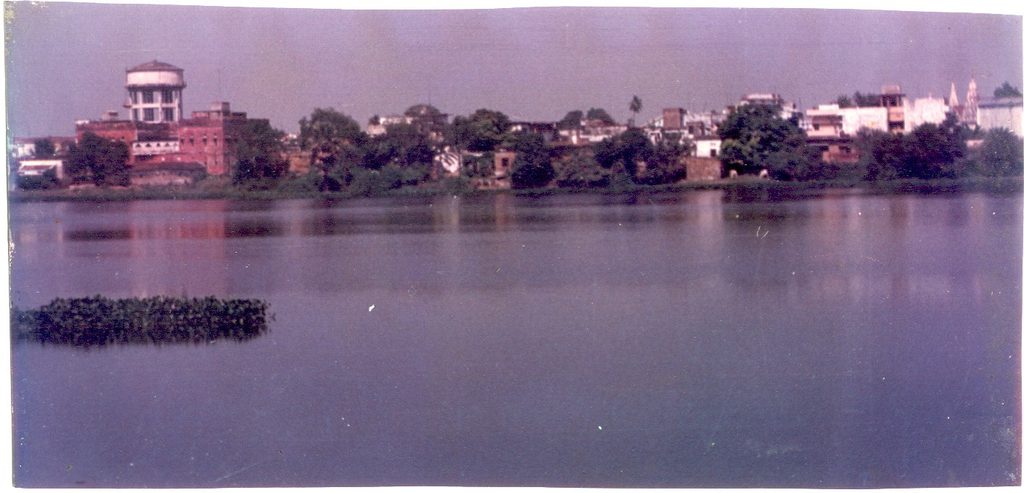
Historical Background & Establishment
The District and Sessions Court at Motihari (East Champaran) holds a distinct place in Indian legal and political history, serving not only as an administrative pillar of North Bihar but also as the cradle of India’s first civil disobedience movement
Origins under Colonial Administration (1866): Champaran was carved out as an independent administrative district from Saran in 1866, with Motihari established as its headquarters. Subordinate courts, munsif magistrates, and revenue adjudication began operating in Motihari shortly thereafter to handle land settlements, revenue collections, and tenancy conflicts between European indigo planters and local raiyats.
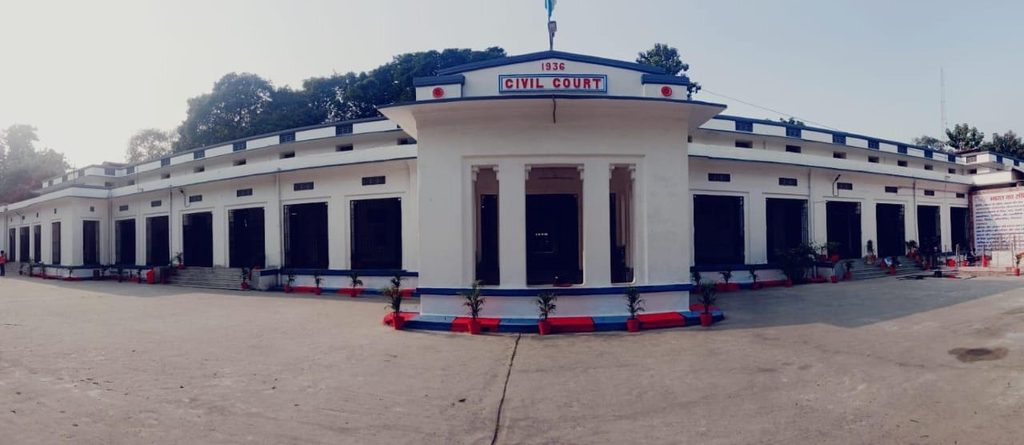
Bifurcation into East Champaran (1972)
On November 2, 1972, Champaran was formally bifurcated into East Champaran (headquartered at Motihari) and West Champaran (headquartered at Betiah). Motihari became the principal civil and sessions division for East Champaran, eventually expanding to house subordinate divisions such as Sikrahana (Dhaka), Raxaul, and Pakridayal.
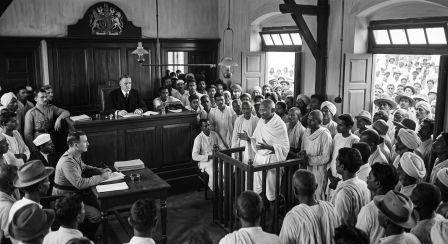
The Landmark Trial: King Emperor v. M.K. Gandhi (April 18, 1917)
The most defining case in the court’s history occurred inside the courtroom of the Sub-Divisional Magistrate, George Channer, in Motihari. Mahatma Gandhi arrived in Motihari in April 1917 upon the invitation of local farmer Raj Kumar Shukla to investigate the abuses of the oppressive Tinkathia system.
Motihari and its surrounding villages are deeply tied to the Champaran Satyagraha of 1917. The memorial sites—including the Gandhi Smriti complex near the court area and the memorial at Chandrahiya (where Gandhi was stopped on an elephant on his way to inspect peasant distress)—serve as national tributes to India’s first civil disobedience movement.
The District Magistrate issued an order directing Gandhi to leave Champaran under Section 144 of the Code of Criminal Procedure. When Gandhi refused, he was summoned to face trial on April 18, 1917.The Courtroom Scene: Over 2,000 peasants surrounded the Motihari court premises. When the magistrate sought to defer the hearing or release him on bail, Gandhi refused to furnish bail and entered a plea of guilty, delivering his historic statement: “I have disregarded the order served upon me not for want of respect for lawful authority, but in obedience to the higher law of our being, the voice of conscience.“
The Outcome: Shaken by the public mobilization, the magistrate reserved judgment, and the Lieutenant Governor of Bihar and Orissa subsequently directed the withdrawal of the case against Gandhi. This marked the first practical victory of Satyagraha on Indian soil, which led directly to the formation of the Champaran Agrarian Enquiry Committee and the passage of the Champaran Agrarian Act, 1918
Agrarian & Tenancy Jurisprudence
Throughout the late 19th and early 20th centuries, the Motihari courts were the testing ground for disputes arising under the Bengal Tenancy Act, 1885, specifically concerning sharbeshi (rent enhancement) and tawan (lump-sum compensation demanded by planters to release tenants from the indigo contract).
Modern Judicial Hub
Today, the Motihari District Court encompasses specialized benches, including Exclusive Special Excise Courts, Motor Accident Claims Tribunals (MACT), Family Courts, POCSO/Rape Special Courts, and the District Legal Services Authority (DLSA), handling one of the highest case volumes in the Tirhut Division.
PROMINENT FIGURE ATTACHED WITH THIS COURT
During the 1917 Satyagraha and the decades following, the Motihari Bar served as the operational nerve center for prominent legal luminaries of India’s freedom movement:
Dr. Rajendra Prasad: The accomplished lawyer who later became the first President of India, who arrived at Motihari Court alongside other advocates to cross-examine and record thousands of peasant depositions (raiyats’ statements).
Babu Gorakh Prasad: A senior advocate of the Motihari Bar whose residence served as Gandhi’s operational headquarters and base camp during the movement.
Dharnidhar Prasad & Ramnavmi Prasad: Respected local advocates who gave up lucrative legal practices to take up peasant causes pro bono in the Motihari courts.
Babu Brajkishore Prasad & Dr. Anugrah Narayan Sinha: Eminent legal practitioners who assisted in legal drafting and challenging planters’ eviction notices and rent-enhancement suits.
George Orwell
Renowned English novelist and essayist Eric Arthur Blair—better known by his pen name George Orwell (author of 1984 and Animal Farm)—was born in Motihari on June 25, 1903. His father, Richard Walmesley Blair, worked as an Opium Agent for the Indian Civil Service. The colonial bungalow and surrounding grounds have been conserved as a commemorative heritage monument.
Other Historical & Cultural Landmarks in East Champaran
Someshwar Nath Mahadev Temple (Areraj): Located about 28 km from Motihari, this ancient Shiva shrine attracts thousands of pilgrims, especially during Shravani Mela.
Lauriya Areraj (Ashokan Pillar): Close to the temple in Areraj stands a 36-foot-high monolithic stone column erected by Emperor Ashoka in 249 BCE, bearing six royal edicts engraved in Brahmi script.
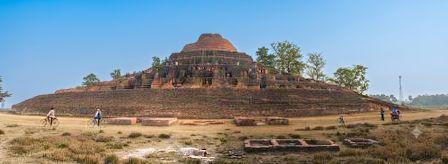
Located roughly 35 km from Motihari town, the Kesaria Stupa is one of the tallest Buddhist stupas in the world, standing at around 104 feet. Dating back to the Maurya, Sunga, and Gupta periods, it marks the sacred spot where Lord Buddha spent his last days before attaining Mahaparinirvana and presented his begging bowl (alms bowl) to the Licchavis of Vaishali.