
Historical Background and Establishment
The Patna Judgeship is one of the oldest in eastern India. According to the records maintained in the District Judge’s Record Room, a judgment dating to the year 1783 survives on file, indicating that the Judgeship was already functioning between 1757 and 1783 — that is, within a generation of the Battle of Plassey (1757) and the grant of Diwani rights over Bengal, Bihar and Orissa to the East India Company (1765). An index plan of these early records is preserved in the Record Room to this day.
Bankipur (also spelt Bankipore), where the court complex stands today, developed from the late eighteenth century as the civil station of Patna — the seat of the Commissioner, the District Magistrate, the courts, and a growing cluster of colonial public institutions — while the older, densely populated city continued to be centred around present-day Patna City. Local tradition holds that the name Bankipore derives from Mir Baqi (‘Banki’), a fifteenth-century military commander associated with campaigns in Bengal and Bihar. Until 1916, Bihar possessed no High Court of its own, and the Patna Judgeship functioned under the jurisdiction of the High Court of Judicature at Fort William in Calcutta. The Patna High Court was established only in 1916, following the creation of the separate Province of Bihar and Orissa in 1912, after which Bankipur’s courts came within the administrative fold of the new High Court, whose own building was raised a short distance away and whose foundation stone had been laid in 1913 by Viceroy Lord Hardinge.
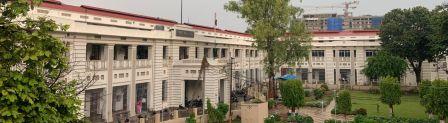
The district of Patna, in its modern administrative shape, is recorded by L.S.S. O’Malley in the Bihar & Orissa District Gazetteers (revised edition, 1924) as having come into being in 1825, with concurrent boundaries for revenue and police purposes that remained largely undisturbed until 1865. Charles Francis Grand is recorded as the first Magistrate of Patna.
Bifurcation into Several Parts
The undivided Patna district and its Judgeship, like Muzaffarpur and other great charges of colonial Bihar, has been progressively reorganised and reduced in size over two centuries as new judgeships were carved out to bring justice closer to litigants:
Shahabad (Arrah) — separated as an independent district and judgeship in the colonial period; itself further reorganised in independent India into the present-day districts of Bhojpur, Buxar, Rohtas and Kaimur.
Gaya — separated as an independent district and judgeship in the colonial period, forming the nucleus of what is today the Magadh Division.
Nalanda (Bihar Sharif) — carved out of Patna district on 9 November 1972; its separate Judgeship, with headquarters at Biharsharif and sub-divisional courts at Hilsa and Rajgir, was formally inaugurated on 6 May 1978 by the then Chief Justice of the Patna High Court, Hon’ble Mr. Justice K.B.N. Singh
Jehanabad — a sub-division of Gaya district since 1872, it became a separate district in 1986 and a separate Sessions Division/Judgeship on 30 November 1992.
Arwal — further carved out in the twenty-first century from Jehanabad, completing the modern map of what was once undivided Patna-Gaya-Shahabad territory.
Even within present-day Patna district, the workload of the parent Judgeship has necessitated internal bifurcation into sub-divisional courts. Patna district today functions through the Sadar (Bankipur) courts together with five sub-divisional courts — at Patna City, Danapur, Masaurhi, Barh and Paliganj — each with its own civil, criminal and executive courts, all administratively tied to the Principal Judgeship at Bankipur. What survives today as the “Patna Judgeship” is thus a far smaller, more manageable charge than the sprawling eighteenth-century district, though it remains, by virtue of Patna’s status as State capital, the single busiest and most consequential district judgeship in Bihar.
Modern / Present Situation
The District Court of Patna functions today from its complex behind the Bankipur Post Office on Kunwar Singh Road, adjoining the Patna University campus, and remains under the administrative superintendence of the Patna High Court, located only a short distance away. As the principal trial court of the State capital’s own district, it carries one of the heaviest caseloads of any judgeship in Bihar, and its structure reflects that scale:
Like other judgeships in Bihar, Patna has been integrated into the e-Courts Mission Mode Project, offering online case-status tracking, cause lists and e-filing facilities, along with hybrid and video-conferenced hearings. Given Patna’s dense urban caseload and its role as the administrative and legal capital of the State, questions of court infrastructure, additional courtrooms, and faster case disposal remain continuing priorities for the Judgeship, even as digitisation steadily improves access for litigants and the large Patna Bar that practises before it.
- The Court of the Principal District and Sessions Judge, with a large complement of Additional District and Sessions Judges;
- Civil Courts of Subordinate/Sub-Judges and Munsifs at the Sadar (Bankipur), and at each of the sub-divisional headquarters of Patna City, Danapur, Masaurhi, Barh and Paliganj;
- The Court of the Chief Judicial Magistrate, with numerous Judicial Magistrates of the First Class and Additional Chief Judicial Magistrates, for criminal trials at Sadar and each sub-division;
- Special Courts, including a Special Judge (CBI) and a Special Court for Economic Offences, reflecting Patna’s role as the seat of major corruption and financial-crime prosecutions;
- A Family Court and POCSO/Fast-Track Special Courts for matrimonial matters and offences against women and children;
- The Motor Accident Claims Tribunal and the Consumer Disputes Redressal Commission;
- The District Legal Services Authority (DLSA), Patna, organising Lok Adalats, legal aid clinics and panel-lawyer empanelment.
Prominent Legal Figures Associated with the Court
Because Patna was, for over a century, the sole seat of superior legal practice in Bihar — first as the site of the principal district and sessions court under the Calcutta High Court, and after 1916 as the seat of the Patna High Court as well — the Patna Bar produced an unusually large number of India’s most distinguished lawyer-statesmen. Many of them began their careers, or maintained lifelong practice, before the district and sessions courts at Bankipur even as their reputations grew at the High Court bar.
Sir Syed Ali Imam
A leading barrister of Patna, Sir Ali Imam served as Law Member of the Government of India and, in 1917, as a Judge of the newly created Patna High Court, before returning to private practice and public life.
Syed Hasan Imam
Brother of Sir Ali Imam and regarded by contemporaries such as C.R. Das as among the finest barristers of British India, Hasan Imam practised extensively at the Patna Bar and was elected President of the Indian National Congress in 1918.
Sir Sultan Ahmed
A highly successful barrister of Patna — with victories on record even against stalwarts such as Motilal Nehru and Tej Bahadur Sapru — Sir Sultan Ahmed later became the first Indian Vice-Chancellor of Patna University.
Maulana Mazharul Haque
Born in Patna district, Mazharul Haque trained as a barrister in London before building a substantial practice, first at Chhapra and then at Patna from 1906 onward. A close associate of Mahatma Gandhi during the Champaran Satyagraha, he later founded Bihar Vidyapith.
Dr. Sachchidananda Sinha
A lawyer and one of the principal architects of the separate State of Bihar, Sachchidananda Sinha began practice at the Allahabad High Court before moving his practice to Patna upon the High Court’s establishment in 1916; he went on to become the first (interim) President of the Constituent Assembly of India.
Dr. Rajendra Prasad
India’s first President was himself a distinguished lawyer who shifted his base to Patna in 1916 with the founding of the Patna High Court, becoming closely associated with the Patna Bar before he gave up practice altogether in 1921 to join the freedom movement full-time.
Pandit Lakshmi Kant Jha and other jurists
The Patna Bar’s stature is further reflected in the fact that Pandit L.K. Jha, then Advocate General of Bihar, was directly appointed Chief Justice of the Patna High Court — a rare instance in Indian judicial history of a sitting law officer elevated straight to the office of Chief Justice.
Landmark Trials & Legacy
The Patna Case — Nauderah Begum v. Bahadur Beg (1777–1779)
One of the earliest and most consequential disputes touching Patna’s judicial administration was what came to be known as the “Patna Case.” Nauderah Begum, widow of a Patna resident, alleged that her late husband’s nephew, Bahadur Beg, had produced a forged will and used the local Diwani Adalat at Patna — through its qazi and muftis — to seize her inheritance without due process. When she approached the newly established Supreme Court at Calcutta, it examined the conduct of the Patna judicial officers and controversially asserted its jurisdiction over the Company’s local courts and officials. The case became a landmark in defining the relationship between the Crown’s Supreme Court and the Company’s provincial Adalat system, including that functioning at Patna, and is still studied as an early chapter in the constitutional history of the Indian judiciary.
In the twentieth century, the courts of the Patna Judgeship — both before and after the creation of the Patna High Court in 1916 — tried numerous cases arising from the freedom movement, and in more recent decades have handled high-profile prosecutions, including proceedings connected with major corruption and economic-offence cases for which the Judgeship maintains a dedicated Special Judge (CBI) and a Special Court for Economic Offences at Bankipur.
The Patna Wahabi Trial (1865 and 1870–71)
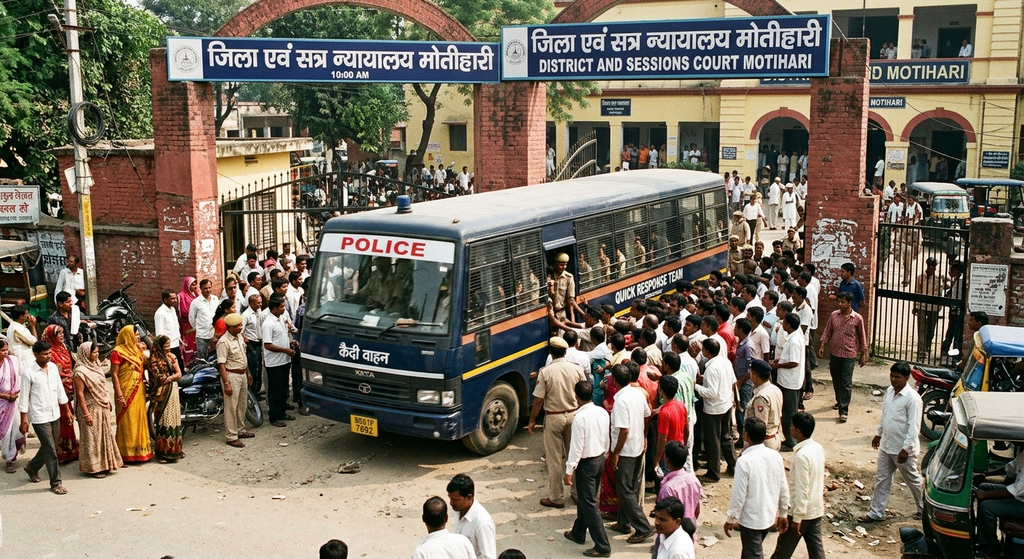
Patna occupies a central place in the history of the nineteenth-century Wahabi (Wali-Ullahi) trials, in which the colonial government prosecuted the leadership of a movement it regarded as waging jihad against the Crown along the North-West Frontier. Sadiqpur, in Patna City, was the movement’s principal centre in eastern India, led by Maulvi Ahmadullah and his family. Following the Ambala Trial of 1864, Maulvi Ahmadullah was arrested on 5 November 1864 on a charge of conspiracy to wage war against the Queen. The court at Patna tried and sentenced him to death on 27 February 1865, with orders for confiscation of his property; the sentence was subsequently commuted on appeal to transportation for life, and he was shipped to the Andaman Islands in June 1865 as one of the first Wahabi prisoners transported there. Further related trials followed at Patna in 1870–71. These prosecutions are historically significant beyond Bihar: the political anxieties they generated fed directly into the introduction of the law of sedition into the Indian Penal Code in 1870, making the Patna trials an important, if sobering, landmark in the legal history of colonial India.
Important Places in and around Patna Town
The court at Bankipur sits in one of the most historically dense parts of Patna, and a litigant, advocate or visitor will find a wealth of connected landmarks close at hand:
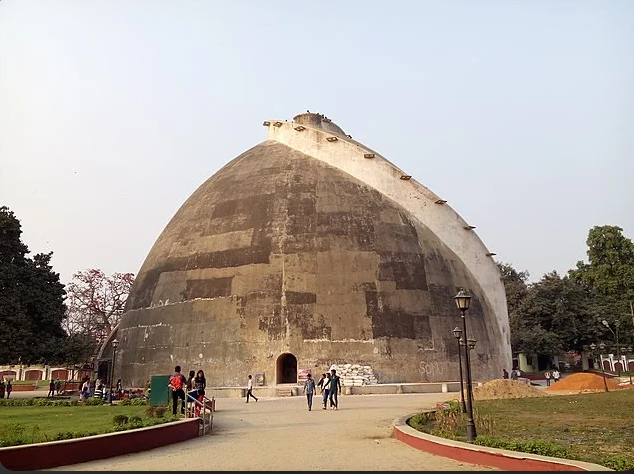
Golghar — the iconic domed colonial granary (1786), one of Bankipur’s most recognisable landmarks.
Khuda Bakhsh Oriental Library — a repository of rare Islamic manuscripts, situated in Bankipore and linked historically to several of the Patna Bar’s most eminent figures.
Gandhi Maidan — the historic public ground associated with major events of the freedom movement and public life in Bihar.
Kumhrar — the excavated remains of ancient Patliputra, capital of the Mauryan Empire, a short distance from the modern court complex.
Patna University and Patna College — among the oldest institutions of higher learning in eastern India, immediately adjoining the District Court campus.
Bankipore Club — established in 1864, one of the oldest social clubs in India, once host to figures such as W.G. Grace and Sir Edmund Hillary
Patna Museum and the newer Bihar Museum — housing important archaeological and historical collections, including Mauryan-era artefacts.
Buddha Smriti Park — built on the site of the former Bankipur Central Jail, where numerous freedom fighters, including Dr. Rajendra Prasad, Brajkishore Prasad and Sri Krishna Sinha, were once imprisoned.
Sadaqat Ashram — the historic Congress headquarters on the banks of the Ganga, associated with the Champaran and later freedom movements.
Note: This compilation draws on the official history published by the e-Committee, Supreme Court of India, the Patna High Court’s own published history, and well-documented public accounts of the Kameshwar Singh case, the fodder scam PIL, and the Muzaffarpur shelter home case. Names of currently serving judicial officers and administrative details may be verified against the High Court’s official website (patnahighcourt.gov.in) for the latest position.